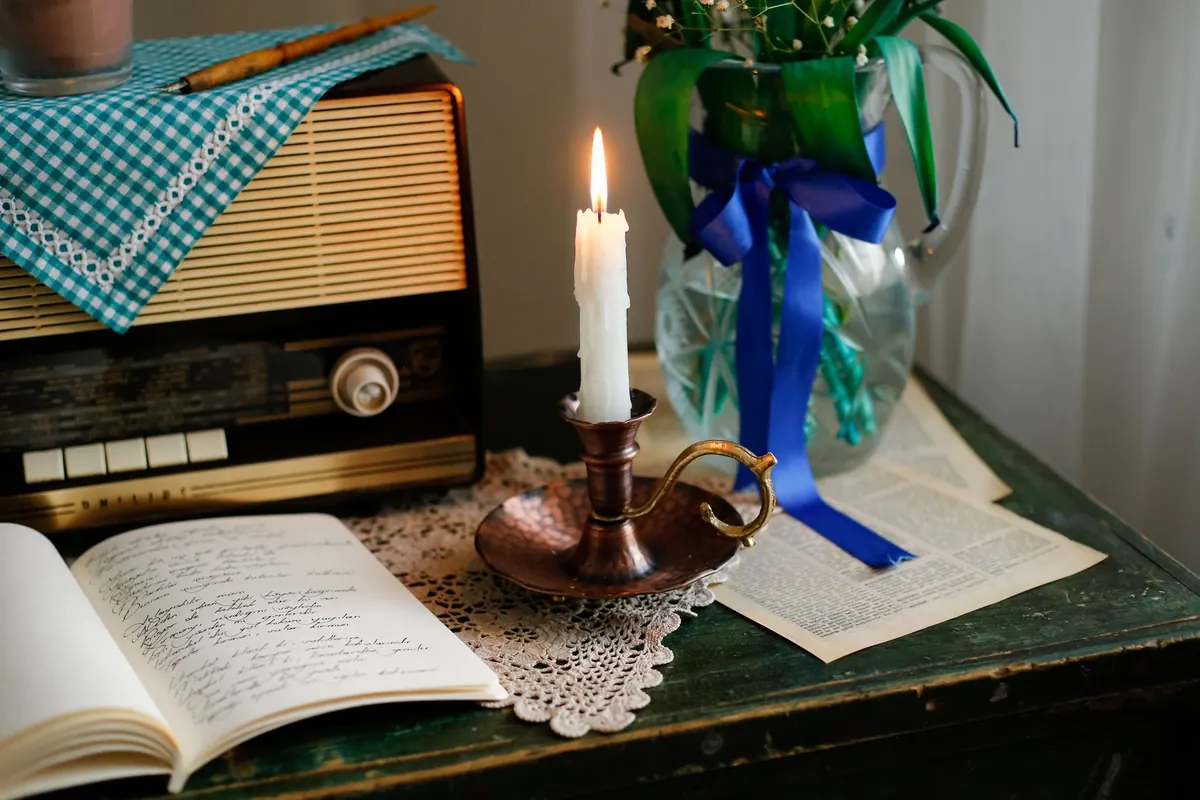
Every Sunday, in a field somewhere, a cardboard sign says "solid brass". Sometimes it's true. Often it's spelter under a coat of gold paint, a die-cast zinc candlestick with a plated skin that has already begun to blister at the foot, or an aluminium ornament that feels like it's made of air. None of that is a crime — plenty of spelter pieces are a century old and worth taking home. The problem is paying brass money for something that isn't brass at all.
You can usually separate the two in under a minute, without a chemistry set and without scratching anything. Work in this order: feel it, look at it, listen to it, test it. Then confirm at home.
Weight comes first, and it rarely lies
Brass is a heavy alloy of copper and zinc. For its size, it should sit in the hand with a stubborn, almost surprising weight — the sort of mass you feel in your wrist, not just your fingertips. Pick up a candlestick and judge it by bulk: if it feels light for the space it takes up, it's probably aluminium, thin zinc, or a hollow casting.
Hollow is not automatically wrong. A great deal of Victorian and twentieth-century brassware was spun or pressed from sheet, and it will be lighter and thinner than a casting. What you're looking for is whether the weight makes sense for how the piece was made. Rap it with a fingernail: sheet brass tends to ring, thick cast brass gives a duller thud, and a flat, dead knock around a rim can suggest a crack or a filled repair.
Watch for the opposite trick, too. Cheap reproductions are sometimes weighted with a lump of resin, cement or a steel nut hidden in the base to make them feel substantial. Turn the piece over and look for fresh filler, an unusually thick felt pad, or a plug that doesn't match the rest of the casting.
Patina: age sits in the corners
Genuine tarnish builds unevenly. It gathers in recesses — the inside of a fluted stem, the depth of an engraved line, under a rim, in the crook of a handle — while the high points stay paler because decades of handling and dusting have rubbed them back. That contrast is very hard to fake convincingly, and it is the single most useful thing to look for.
Signs of honest age
- Dark brown-black tarnish lying deep in the hollows, with brighter, smoother high points
- A faint green film of verdigris in damp crevices, or where two surfaces meet
- Wear where hands would naturally grip: stems, handles, knobs, spout edges
- An underside that is scratched, oxidised and uneven, not freshly ground flat
Signs of a faked finish
- Identical colour from every angle, including places nobody would ever polish
- A finish that looks painted or powdery, or that wipes off onto your thumb
- A sulphurous, chemical smell — the giveaway of an antiquing solution — rather than metal
- Gold paint flaking at the edges, showing grey metal underneath
Seams, joints and the underside
Fakes are usually die-cast, and die-casting leaves razor-thin parting lines where the two halves of the mould met. Run a fingernail across the suspect line. A crisp, perfectly uniform flash line running straight across a curved surface suggests a modern mould. Older sand castings tend to have chunkier, less regular seams that were filed or chattered down by hand, leaving a slightly pitted surface and tool marks.
Spun brass shows fine concentric rings inside a bowl or base. Soldered joints — on candlestick stems, handles, spouts and feet — should be old and oxidised to roughly the same colour as the surrounding metal. Bright grey solder, or a patch of patina that doesn't match its neighbours, is a repair. Repairs aren't fatal, but they should affect what you're willing to hand over.
Wear, screws and other quiet giveaways
Use the object as it was meant to be used and see whether the wear tells the same story. A 150-year-old candlestick has softened, rounded edges and a stem worn smooth where it was lifted, week after week. An object with sharp, crisp edges and an even finish across every surface has probably never been used by anyone.
Then look at the fixings, which are often the quickest way to date a piece:
- Screws. Slotted screws suggest older work; cross-head screws only became common in Britain in the twentieth century, and Pozidriv later still. A "Georgian" lamp held together with cross-heads is not Georgian.
- Felt pads. A fresh glued-on baize base hides whatever is underneath — a thin brass sheet foot or a wooden block. Ask before lifting a corner.
- Hinges and handles. Look for rivets that have worn into their holes, and hinges that have dropped slightly with use.
- Tool marks. Hand-finished edges and slightly irregular hammering are reassuring. Perfectly identical repetition across two "matching" pieces is not.
The magnet test — helpful, but easy to misread
Brass is not magnetic, so a magnet is a useful tool, provided you understand what it can and cannot tell you.
If a magnet clings hard, the body of the piece is iron or steel. That might be cast iron painted gold, or a cheap candlestick with a steel core and counterweight hidden in the stem. Either way, it isn't solid brass.
But a magnet that does nothing proves very little. Zinc, aluminium, spelter, pot metal, pewter and bronze are all non-magnetic too, and every one of them turns up at boot sales dressed as brass. Use the magnet as a way of finding hidden iron — repairs, staples, steel rods, base plates — and not as a certificate of authenticity. A small fridge magnet in your pocket costs nothing and takes up no room.
If a seller won't let you turn a piece over and look at the base, that tells you more than the piece does.
A field checklist for candlesticks, pots and ornaments
- Ask permission before you handle anything, and never scratch or rub a surface at the stall.
- Weigh it in one hand. Heavy for its size is a good sign; light or oddly bottom-heavy is not.
- Turn it upside down. Study the base, the inside of the rim and the underside of the foot.
- Trace the seam lines with a fingernail. Thin, sharp, uniform flash lines mean a modern mould.
- Touch a magnet to the base, the stem and the rim. A strong pull means ferrous metal somewhere.
- Rub a hidden patch with your thumb and smell it. Chemical or paint-like? Be suspicious.
- Check that the wear pattern matches how the object would have been used.
- Inspect the fixings — screws, rivets, solder and any new felt — and ask the seller where it came from. Listen to whether the story fits the object.
The test you can only do at home
Once it's yours, choose a concealed spot — the inside of a candle cup, the underside of a foot — and rub it with a drop of brass polish on a soft rag. If it comes up to a warm yellow gleam that cleans evenly, you have brass. If the cloth comes away with paint, or the surface turns pinkish-copper or grey, you're looking at plating over copper or zinc. Stop there and leave it alone.
Resist the urge to scrub everything back to showroom shine. On most antique brass, the patina is part of the appeal, and over-polishing flattens the surface and hides the very wear that proves age. Warm soapy water, a soft cloth and a dry finish will do for most pieces; keep plated items dry and don't agitate worn patches with abrasives or wire wool. And if you're spending anything more than pocket money, or buying with a view to selling on, get a second opinion from a specialist dealer or auction house before you spend anything on restoration.
Photo: betül nur akyürek / Pexels